


The AP English Language and Composition Exam is an opportunity for high school students to earn college credit and prove that they have challenged themselves academically to college admissions officers. In the Free Response portion of the exam, the first question requires students to read 6 short sources and craft an argumentative essay that clearly takes a position on the issue described in the sources. Knowing what you will be graded on and how to best use your time is a significant advantage on the test. This step-by-step guide allows you to practice the process for developing the synthesis essay on the AP Lang exam, which is FRQ1, the first free response question.
This guide uses the resources available on the Test Preview section of Bluebook Exams digital Ap.
If you have any questions about preparing for the AP English Language and Composition Exam or any other AP Exam, reach out to hello@mindfish.com.
AP Synthesis Essay Rubric
The rubric for the AP Synthesis Essay allows for a maximum score of 6 points:
- 1 point for a thesis that clearly takes a side
- 4 points for a well-developed argument that uses specific evidence from the sources and the student’s analysis and evaluation
- 1 point for complex thought that centers the debate in a larger context or makes connections between the sources
Step 1: Sort the Sources
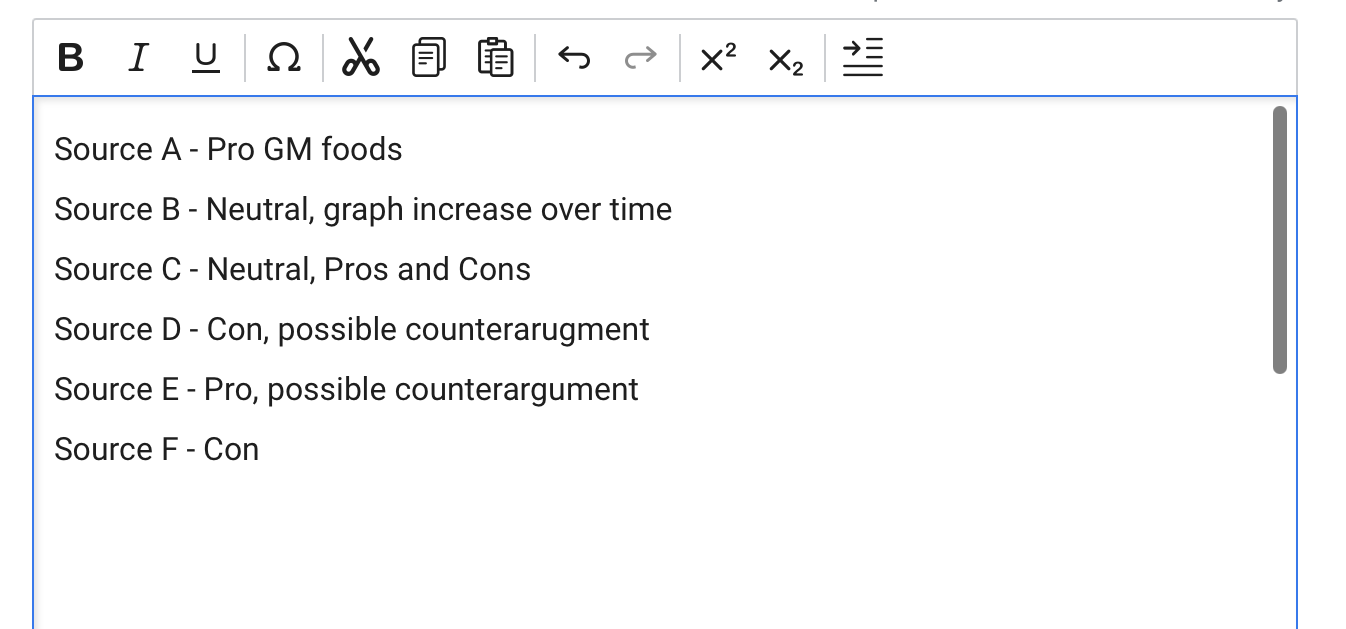
The synthesis essay will include a quick overview of the debate. Skim this first, and start thinking about any outside knowledge you have on the topic. Next, read the title and skim the first paragraph of each source. Sort each source into categories of “pro, con, or neutral.” You can also make notes about potential counterargument evidence at this stage. Make a quick note in your text box that can be erased at the end about the position of each source:
Example:
Step 2: Pick a Side and Look for Evidence
Next, decide which side of the argument you want to support. Skim read the articles that support your position and are neutral. As you read, slow down when you get to quotes that are relevant. Highlight them, and type the ones you want to use into your text box. You will need to cite at least 3 sources in your essay.

Step 3: Make an Outline
Next, make an outline of two body paragraphs about the position and one counterargument paragraph.

Step 4: Write the evidence and analysis portions of your body paragraphs
Many students attempt to write an essay from start to finish before they develop their ideas. This can result in a thesis statement that is too general, and many students lose points at this stage. If students start by evaluating their evidence and developing ideas, they can write a fully developed thesis statement with a roadmap component for each of their two main points.
Example:
Manda writes in a United Nations publication, “Local civic groups and scientists conducted a study tour of the US, India, South Africa and Europe . . . ‘We established from all countries visited that GMOs are a health hazard’” (Source F). Importantly, no single scientific study can adequately inform global policy. The UN’s World Food Programme did an in-depth tour involving citizens and scientists in multiple countries on multiple continents and came to the conclusion that GMO foods are harmful.

Step 5: Write the Thesis Statement
Students receive a point for writing a thesis statement that clearly takes a side. This is also an opportunity to earn a complexity of argument point by creating an argument that qualifies a stance.
Example:
Genetically modified food should be regulated in the global food market to only comprise 25% of the total global food supply due to the alarming health risks documented by scientists and the heavy influence of profit-driven corporations on the expansion of GMO technology.

Step 6: Write the language to connect the argument
Students receive points for a well-developed argument. Write the main idea and link sentences to introduce the topic of each paragraph at the beginning and tie the paragraph back to the thesis at the end.
Example:
GMO crops shouldn’t become the majority of the Global Food Supply due to scientific studies that detail the health risks posed to humans.

Step 7: Write the Intro and Conclusion
Finally, write the intro and the conclusion. No specific points are given for a hook in the introduction, so focus on a couple lines of background to get into your thesis, polishing your thesis statement, and clearly summarizing your argument in the conclusion.
Step 8: Erase all Notes + Proofread
At the end, carefully delete any remaining notes from the brainstorming process. Read through your paper by saying the words under your breath to check for meaning, spelling, and grammar errors.
Additional Support
Students can look at sample AP exam papers by clicking on previous year’s questions. To prepare for the AP Lang exam with an expert tutor, reach out to hello@mindfish.com.
Hannah Brooks
Interested in learning more about Test Prep at Mindfish?
Contact us today to find out what our dedicated tutors can help you achieve.