


Circles on the SAT defy a lot of our mathematical instincts. Compared to the certainty of straight lines, circles seem harder to pin down, with their roundness and the magical but mysterious involvement of the transcendental number π. Certain circle questions, especially ones that use the graph of a circle equation, can be solved with Desmos in ways that are staggeringly simple compared to doing them by hand or even using a graphing calculator.
Don’t forget to check out the rest of our Desmos series!
Area and Circumference Questions Versus Graph of a Circle Equation Questions
Before we get into all the tricks, it’s important to say that there are two main types of circle problem on the SAT, and that one of them benefits much more immensely from Desmos than the other.
Questions about arcs, sectors, area, and circumference are the kind of circle question that might come to mind first when you think of circles, and this type of problem only benefits a little from Desmos. Still, it’s important to mention what you want to know about this problem type, too.
Arc, sector, circumference, and area questions rely on some form of the two equations on the SAT formula sheet that relate to circles (right).

You are generally going to want to know these formulas well, and also be ready to solve portions of the circle’s circumference (arcs) or of the area (sectors) with ratios. The main use of Desmos for this type of question is just as a typical calculator.
Questions about the graph of a circle and its equation will involve variables, usually both x and y, and represent a relation that appears as a circle on the xy coordinate plane.

The equation of an example circle and its graph are shown above. This type of equation cannot be written in such a way that it is a function (just with y equaling the rest), and please don’t try to do so! For this reason, handheld graphing calculators cannot show this type of relation, but Desmos can!
Here is the general circle equation. The coordinate pair (h,k) is the center of the circle, and r is the length of the radius of the circle:

While we are mostly talking about Desmos here, it can also be helpful to have some ability to recognize the parts of one of these equations in action. Take this example:

Even without any Desmos, familiarity with the circle equation can allow us to figure out that this circle has a center at (-3, 4) and a radius of 7.
Circle Equation Questions That Shine with Desmos

What is the radius of the circle described by the equation above?
Without Desmos, the best way to do this problem would be by hand with a method called completing the square. Using an understanding of factoring, we would complete the square for x and for y to get this equation reformatted so that it shows the center and radius of the circle. That skill is specialized and time-consuming, though! It’s great that Desmos does not care at all about how you format this equation: you can type it in as-is and see a picture of the circle.

Desmos suggests intercepts and other significant points for easy highlighting, so it was easy to pick out the highest and lowest points on this circle. You might have been able to figure out that with the highest point having a y-coordinate of 6 and the lowest point having a y-coordinate of -10, the diameter of this circle is 16 and the radius = 8. If you can imagine a trickier circle with less friendly points, though, this is a good time to point out that Desmos can calculate the distance between two points, in a new equation line as in the format below:

Just as you use sliders for any graphing question, you may want to use one or more sliders or substitutions for unknown constants, when the problem decides to throw them our way!
Practice Questions
Try giving circles a shot on your own using Desmos.

The equation above represents a circle, and a is a constant. If the circle passes through the points (3,10) and (3,-6), what is the value of a?

The equation above represents a circle, and c is a constant. Which of the following quadrants could be the location of the center of the circle?
A. Quadrant I
B. Quadrant II
C. Quadrants I and II
D. Quadrants I, II, and III

The line representing the equation above is a circle with center (c, d), where c and d are integer constants. What is the value of c + d ?

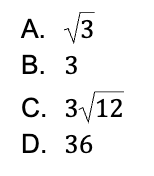
The equation above represents a circle, and a is a positive integer. If the circle is tangent to both the x-axis and the y-axis, what is the value of a?
Answers:
- 3
- B
- –4
- A
Nate Ycas
Interested in learning more about Test Prep at Mindfish?
Contact us today to find out what our dedicated tutors can help you achieve.